


Dragon Puppet – Shrek the Musical (2026)
When my local theatre invited me to join the Dragon Team, I was thrilled. I had already developed a passion for puppet building, and I knew this project had the potential to become one of the show's most memorable visual elements.
For Shrek the Musical (2026), I served as the lead designer for the Dragon's head. One of the first challenges was determining the puppet's overall scale, proportions, and functionality. I wanted Dragon to feel massive and imposing while remaining lightweight enough for performers to operate comfortably throughout the production. After collaborating closely with the mechanical designer and my artistic partner, Maleah Miller, we arrived at the final design showcased here.
Our original plan involved sculpting Dragon from large foam slabs. However, after our foam cutter struggled to cut through the heavily glued layers, we quickly realized the approach wasn't practical. Rather than forcing the design, we adapted. Tony Upton constructed a lightweight cardboard framework that became the foundation of the puppet, giving us a flexible structure to build upon.
From there, the transformation began. Using approximately eight to ten cans of expanding spray foam, my artistic partner and I covered the entire framework to create Dragon's musculature and form. Compared to carving the original foam slabs, shaping the cured spray foam was significantly easier and allowed us to refine the creature's contours with much greater control.
To complete the puppet, we incorporated a variety of materials, including Styrofoam spheres for the eyes, car lashes for added character, paper mache for texture, and multiple layers of house paint and spray paint to achieve the final finish.
Dragon quickly became one of the production's standout pieces. Audience members regularly commented on the puppet after performances, and hearing their excitement at the end of each show was incredibly rewarding. The project challenged my creativity, problem-solving, and ability to collaborate under changing circumstances, ultimately reinforcing my passion for designing immersive theatrical experiences.

Process

Fig. 1
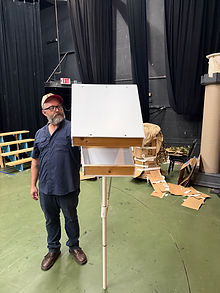
Fig. 2

Fig. 3
The first picture(Fig. 1) shows the foam that was cut to create the stacked foam pieces to sculpt. After further consideration and reaching roughly 15 slabs, we took the approach shown in the next two pictures(Fig. 2 & 3)

Fig. 4

Fig. 5

Fig. 6

Fig. 7

Fig. 8
In the middle of the process, we needed to stage where Dragon was going to be(Fig. 4). There were some cardboard structures and spray foam that created more facial definition before paper mache. We painted each scale using painting techniques to get a cool gradated effect(Fig. 5). For the horns on the side of the face, we sprayfoamed aluminum foil that we formed in the shape of a cone, and shaved it down to look pointy. Then we needed to finish with details(pupil, teeth, and lips)(Fig. 9). Over the course of 3 weeks, a team of 3 were able to make this puppet come to life. I am proud to have been a part of this show's production team, and throughout all of our struggles, we created something beautiful.

Fig. 9